


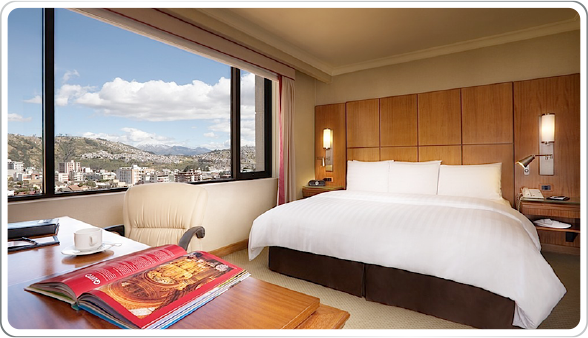




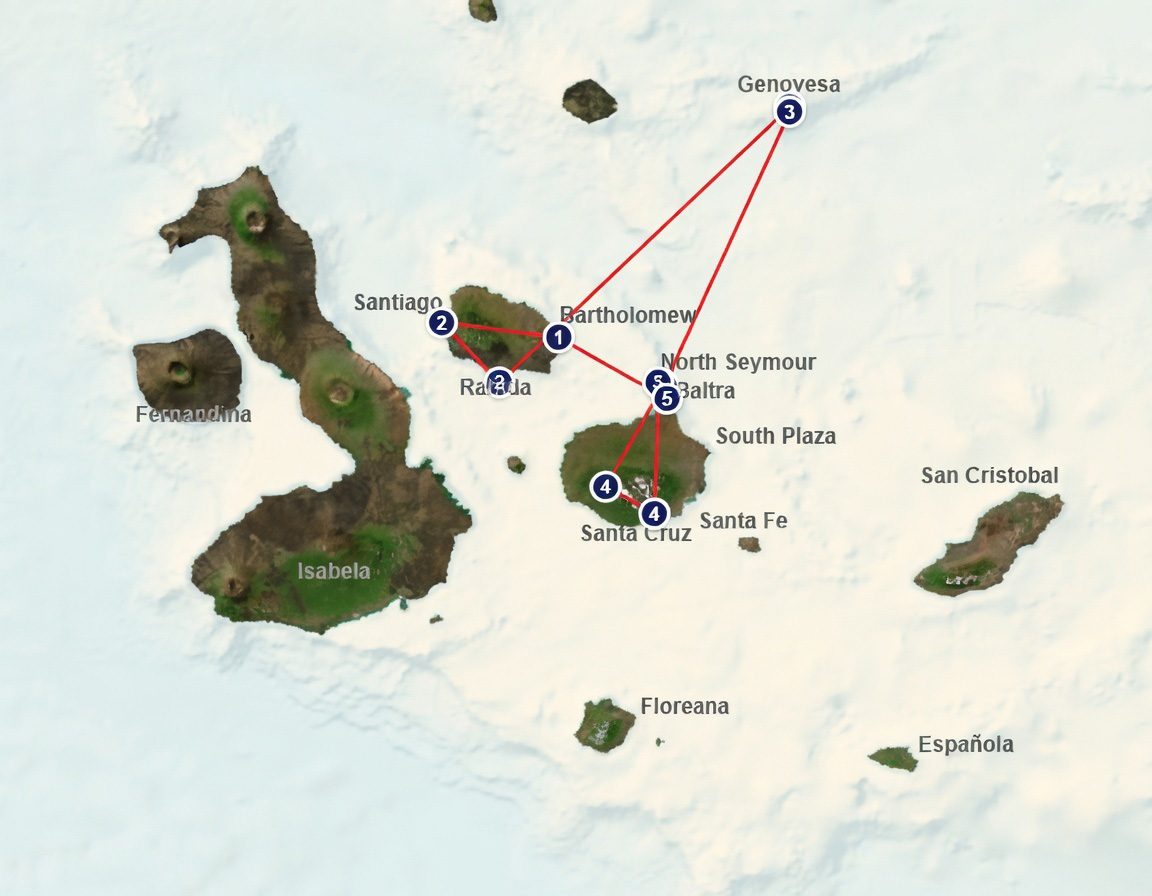
Tuesday to Saturday Itinerary: The 5-day itinerary begins with disembarkation from the cruise ship on Friday and includes 2 nights in a hotel in Puerto Ayora.
AM: Arrival to Baltra Airport and transfer to the boat
PM: Bartholomew Island: Home of the famous Pinnacle Rock, Bartholomew consists of an extinct volcano with a variety of red, orange, black and even green volcanic formations. A trail of stairs leads to the summit of the volcano, boasting one of the best views of the islands. The beach is perfect for snorkeling and possible sightings of the Galapagos penguin.
AM: Egas Port, Santiago: Also known as James Bay, Egas Port is home to the curious Galapagos hawks and quick-footed Galapagos lava lizards. The trail leads to a coastline with gorgeous tide pools and grottos full of fauna. Here the Galapagos fur sea lions bathe in the sun. This is also a great snorkeling site
PM: Rabida Island: Rabida Island (Jervis) is one of the most colorful and volcanically varied islands in the archipelago and a great snorkeling site. Its famous maroon sandy beach and stunning lookouts provide wonderful landscapes. The island is a birdwatcher’s delight. Some of the rarest species are in abundance, such as nine varieties of finches, large-billed flycatchers, Galapagos hawks and brown pelicans.
AM: Darwin Bay, Genovesa: This white sand coral beach heads a half mile trail (0.75km) that winds through mangroves filled with land birds. Nazca boobies, red-footed boobies, and swallow-tailed gulls can be spotted here. Further down the path are tidal pools where sea lions swim playfully. At the end is a spectacular view off a cliff.
PM: El Barranco, Genovesa: Also known as Prince Phillip’s Steps, El Barranco’s steep, rocky paths leads up to a high cliff-face. A marvelous view can be appreciated from here. This site is also home to palo santo vegetation as well as red-footed boobies, short-eared lava owls, Galapagos swallows, and Galapagos doves.
AM: Mosquera Islet: Located between the islands of Baltra and North Seymour, this reef of rocks and coral (the result of an uprising) is only 160 meters across at its narrowest width. This island has one of the largest populations of sea lions and is home to many shorebirds. There have been occasional reports at this site of orcas feeding on sea lions.
PM: Santa Cruz Highlands, Santa Cruz: Reached by bus from Puerto Ayora, the highlands of Santa Cruz are a deep green contrasting beautifully with much of the dry, lower islands. The dominant vegetation in the highlands is the forest of Scalesia trees creating the lush green color. The lava tubes, over half a mile long, are underground and walking through them is a unique, surreal experience.
AM: North Seymour Island: Galapagos sea lions, blue-footed boobies and magnificent frigatebirds are abundant on North Seymour Island. The island was formed by a series of submarine lava containing layers of sediment that were uplifted by tectonic activity. The island is characterized by its arid vegetation zone.
PM: Transfer to Baltra Airport for departure.
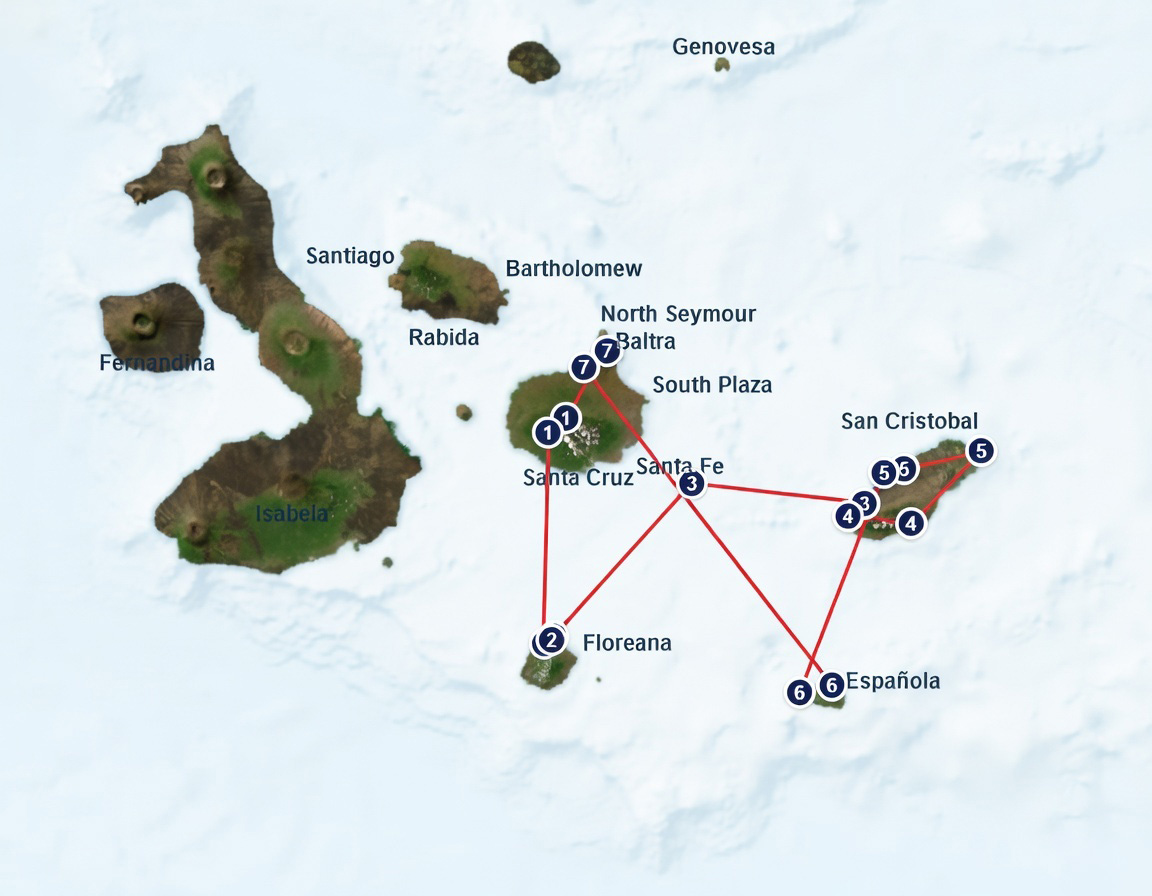
Wednesday to Tuesday Itinerary*: Exploring Western and Central Islands.
AM: Arrival to Baltra Airport and transfer to first excursion.
PM:
Twin Craters, Santa Cruz: Los Gemelos, or the Twin Craters, are located opposite each other on both sides of the road leading from Puerto Ayora to Baltra. The name is only figurative; not real craters, these formations were created by the collapse of surface material in underground fissures and chambers. The view is breathtaking.
Santa Cruz Highlands, Santa Cruz: Reached by bus from Puerto Ayora, the highlands of Santa Cruz are a deep green contrasting beautifully with much of the dry, lower islands. The dominant vegetation in the highlands is the forest of Scalesia trees creating the lush green color. The lava tubes, over half a mile long, are underground and walking through them is a unique, surreal experience.
AM:
Post Office Bay, Floreana: In the 18th century whalers passing through the islands placed a wooden barrel on Floreana Island for use as an unofficial mail box. The tradition continues today as visitors leave addressed postcards in the barrel and sort through left mail to deliver at home.
Devil’s Crown, Floreana: One of the best snorkeling sites in the Galapagos, this volcanic crater has been eroded by the waves leaving the northern and southern sides poking out of the water. The coral reef in the middle is perfect for attracting marine life. Snorkelers enjoy the variety of marine life and exciting currents that rush through the crown creating an exhilarating experience.
PM: Cormorant Point, Floreana: This site hosts a large flamingo lagoon where other birds such as common stilts and white-cheeked pintails can also be seen. The beaches on this island are distinct: The “Green Beach” named so due to its green color, which comes from a high percentage of olivine crystals in the sand, and the “Four Sand Beach” composed of white coral.
AM: Santa Fe Island: Santa Fe (Barrington) is home to the small picturesque bay and anchorage on the island’s northeast coast. The bay has two visitor trails, one leading to a scenic viewpoint atop a cliff, and the other spanning from a small beach to a tall prickly pear cactus forest.
PM: Lobos Island, San Cristobal: The name of this island means “Sea Lion Island.” This appropriately named island is ripe with noisy, frolicking, jolly sea lions who will welcome you to their home with open, well, fins. This island also offers great snorkeling opportunities as well as the chance to see blue-footed and Nazca boobies.
AM: Gianni Arismendy Interpretation Center, San Cristobal: The Gianni Arismendy Interpretation Center was opened in 1998 as a phase of the project “Interpretation and Environment Education Project.” Visitors enjoy expositions on natural history, human history, and conservation. The conservation efforts represent the movement to protect the wildlife and natural environment through means of population and tourist control. The Gianni Arismendy Interpretation Center has an outdoor stadium, audio-visual equipment, and meeting rooms.
PM:David Rodriguez Breeding Center, San Cristobal: This visitor site in the southeast part of San Cristobal Island can be reached in roughly one hour by road from Puerto Baquerizo Moreno. In the Breeding Center, you will be able to admire the hatchling turtles from their birth until the are 120 days old when the grown turtles are taken to their natural habit.
AM: Pitt Point, San Cristobal: Pitt Point, situated on the northeastern tip of the island, hosts frigatebirds, storm petrels, and all three types of booby birds: the Nazca, blue-footed and red-footed boobies. A steep trail goes up a cliff and through a ravine leading visitors to an area with an abundance of birds. This site is also great for snorkeling and scuba diving.
PM:
Witch Hill, San Cristobal: Located on the northern coast, this eroded hill and its surroundings present one of the most picturesque beaches in the Galapagos with its white powdery sand and the abundance of animals. Wildlife includes sea turtles, rays, and various types of booby birds. The clear water provides an excellent opportunity for enjoying swimming and snorkeling.
Kicker Rock, San Cristobal: This striking rock formation is located a couple hours off the western shore of San Cristobal. Jutting out of the water, the rocks stand vertically at hundreds of feet above the ocean divided by a small channel. Although there are no landing areas, circumnavigation and dinghy rides allow visitors to spot a variety of marine life.
AM: Suarez Point, Española: This area is great for spotting blue-footed boobies, albatrosses and Nazca boobies. A beautiful site on the ocean front, the large waved albatrosses use the cliff as a launching pad. The famous attraction is the magnificent blowhole, spurting water high into the air. This site presents wonderful photograph opportunities.
PM: Gardner Bay/Islet, Osborn Islet, Española: Gardner Bay, on the eastern side of the island, is the breeding site of nearly all of the world´s 12,000 pairs of waved albatrosses. It has an ample white sandy beach with a myriad of sea lions, perfect for relaxing. Its rocky shores make this site a great place for diving and snorkeling.
AM: Bachas Beach, Santa Cruz: Located on the north shore of Santa Cruz, Las Bachas is a swimming beach. One of the few remnants of the U.S. World War II presence in the Galapagos, a floating pier, can be seen here. You may see flamingos, Sally Lightfoot crabs, hermit crabs, black necked stilts, and whimbrels. Sea turtles also nest off the beach.
PM: Transfer to San Cristobal Airport for departure.